


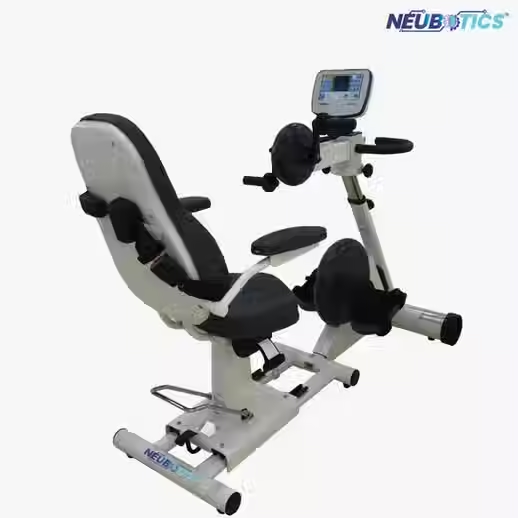


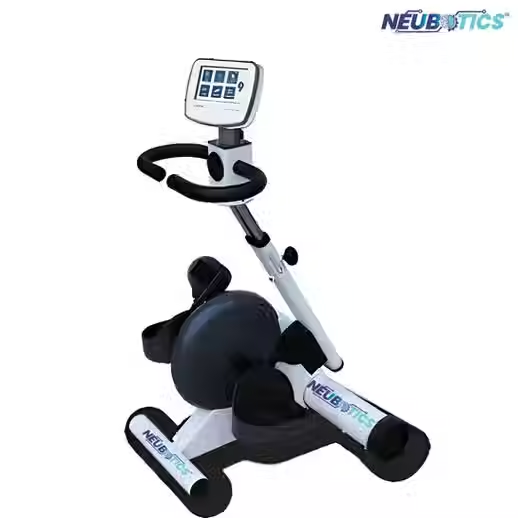


APT-2000A — 5-Mode Active and Passive Trainer for Upper and Lower Limb
₹0.00
APT-2000A Active and Passive Trainer for Upper and Lower Limb is a multifunctional rehabilitation device designed for functional training of both upper and lower limbs in patients who are in recovery or have residual deficits (sequelae) from conditions such as stroke, brain injury, joint surgery, musculoskeletal injuries, It combines evaluation with training modes (passive, assistive, active, isokinetic, etc.) so that a therapist can tailor therapy as the patient’s strength and control improve.
Five Training Modes — From Complete Paralysis to Full Strength Recovery
- Passive Mode — Motor-Driven Limb Movement : Passive motion training driven by motor. When the patient has no voluntary movement capacity, the APT-2000A's motor drives the arm handles and/or foot pedals through a pre-set range of motion at a controlled speed in patients who cannot initiate any active movement. An ultra-quiet hybrid stepper motor is used for smoother and lower-noise operation, ensuring patient comfort during extended passive sessions and appropriate noise levels for ward environments. The passive mode speed is adjustable from 1 to 60 RPM.
- Assist (Boost) Mode — Detecting and Amplifying Residual Muscle Strength - Motor-assisted power-assisted exercise training; the machine detects the remaining muscle strength and automatically gives auxiliary power. A force sensor continuously measures the patient's voluntary force output during the exercise cycle. When the voluntary force falls below the threshold needed to maintain the prescribed movement speed, the motor automatically provides exactly the additional force needed — no more, no less. When voluntary force increases, motor assistance decreases proportionally.
- Active-Passive Mode — Seamless Transition Without Gap - The active-passive mode enables the device to continuously transition between motor-driven passive movement and patient-driven active movement within the same session — automatically detecting when the patient's voluntary effort exceeds the passive drive threshold and seamlessly switching to active resistance mode, then reverting to passive assistance when voluntary effort drops.
- Active Mode — Progressive Resistance Strengthening : The motor is disengaged and the patient exercises against the device's adjustable magnetic resistance — with resistance adjustable from 0 to 20 Nm in 1 Nm increments (20 discrete levels) for both upper and lower limbs — incrementing resistance by 1 Nm as the patient's strength improves — and the documentation of force output across sessions provides objective evidence of strengthening progress.
- Isokinetic Mode — Constant Speed with Variable Resistance : Maintaining a constant angular velocity while resistance automatically varies to match the patient's instantaneous force output throughout the movement arc. By incorporating isokinetic mode, the APT-2000A provides a clinical capability typically associated with dedicated isokinetic dynamometry systems (Biodex, Cybex) — at a fraction of the cost and within the same device used for all other rehabilitation modes.
Quantity
Technical Specifications
|
Specification |
Detail |
|
Application |
Adult upper and lower limb rehabilitation |
|
Training Modes |
5 — Passive, Assist, Active-Passive, Active, Isokinetic |
|
Passive Speed Range |
1–60 RPM (1 RPM increments) |
|
Active Resistance Range |
0–20 Nm (1 Nm increments, 20 levels) |
|
Motor Type |
Ultra-quiet hybrid stepper motor |
|
Spasticity Protection |
Automatic — stop + low-speed reverse |
|
Evaluation Function |
Quantitative assessment integrated |
|
Patient Management |
Digital patient file + automatic data generation |
|
Upper Limb Coverage |
Yes (arm handle attachment) |
|
Lower Limb Coverage |
Yes (foot pedal attachment) |
|
Training Time Range |
1–120 minutes (1-minute increments) |
|
Voltage |
220V / 110V AC |
|
Packaging Dimensions |
113 × 71 × 152 cm |
|
Gross Weight |
101 kg |
|
ISO Certification |
ISO 13485, ISO 9001 |